Monday, March 18, 2019

#CSW63 Reflections

Saturday 16th March 2019

So this week has been a rollercoaster, even for an experienced activist like me.

This week has given me an opportunity to have conversations with sisters who are fighting the struggle in their own ways.  Many of us feel alone in our struggles but this week has demonstrated that each little action we take in our own little corner of the world, we are all weaving in our part of the tapestry.  This week has helped me re-examine and shape my own feminist lens, but this hasn't been without it's challenges.

This week has been both exhausting and recharging at the same time, inspiring and frustrating in tandem and hope-building and despairing, all in one.

I leave this week feeling frustrated that at times we are still fighting the same issues, I am sad that our girls are still feeling vulnerable and unsafe in the very places they should feel safe and secure. I am disappointed that the same experiences I've had and spoken out in the past about are still being experienced in the present.

On the other hand, I am inspired that the next generation are increasingly not accepting the behaviours of the past, that our young sisters have got voices they refuse to allow to be silenced.  I am hopeful that our voices, united will never be defeated.  I feel recharged meeting sisters of all generations, at multiple levels of activism being in one space sharing the positives of their activism.

I am privileged to be an educator who has the space to help all young people find their voices to take our society in the next century.

We are involved in a struggle against a patriarchal system that has taken centuries to embed. It is a patriarchal system that doesn't even benefit all men, let alone women.  It is based on benefitting those with the resources and for those who don't, then they are also victims of it's success. The issue is that it sells a version of success based on a sense of ambition that is built on the degradation of others. Whether this is based on race, ethnicity, gender, disability status, sexual orientation, class, economic status the system is balanced on a hierarchy of haves versus have nots.

This system has mutated into many forms and takes diverse shapes in different communities and countries around the work.  Based on our own intersectional identities, we engage with these systems in different ways, meaning that out fight back adapts to fight it in different ways.

Over the week I have been a part of the Educational International delegation, sitting alongside sister educators from across the world and feeling that we are all on the same page.  I have heard that a lot of the work to educate about gender equality and safe spaces for all, starts in the classroom and we are there to facilitate it.

However teachers (and women teachers) are facing battles in our profession that are trying to push us out.  Women make up about 75% of the workforce yet we are underrepresented in senior leadership roles and curriculum development positions. The longer we stay in teaching, the more 'expensive' we are, so older women teachers are often targeted for capability or are bullied out of the profession.  Our subjects are being classed as 'soft' which means they are expendable from the curriculum and we are being set up to fail through teaching subjects outside of our training.
As women teachers we face pay suppression and lack of promotion opportunities.   We are fighting to stay in the classroom so we can continue to do the vital work that is needed outside of our classrooms.

During #CSW63, one message has stayed with me through out this experience, a half of our population are having their potential restricted and limited. Women and girls inspire the next generation as we are the mothers, aunties, grandmothers who directly influence the lives of babies and children.  We are the teachers, babysitters, educators, coaches for children as women are the majority of the domestic sector, this is undeniable.

Women's rights are Human Rights!

In the words of the Secretary-General of the UN, himself:

"The bottom line is simple: When we exclude women, we all pay the price. When we include women, the world wins. We all win."

This fight is one that we have all got a role to play and we all must continue to add our single threads to the tapestry of a more equal and just society, for all.  Thank you EI and NASUWT for allowing me to strengthen the thread that I am weaving through my own experiences.


#CSW63 Taking Action

Friday 15th March 2019

And so we are coming to the end of our time here at #CSW63 and what better way to bookend a week of empowerment and engagement than standing in solidarity with NY students taking action in the youth strike for climate change.  Students and young people across the world have called for a day of action to demand that our negative impact on our environment is prioritised by those with the power to make change.

For young people who are disenfranchised through the democratic process (not able to vote) and the legal process (age of legal responsibility), the only way they can amplify their voices is often through action. 

Unfortunately this is also the why those with political power undermine the voices of young people.  "Why should we listen to young people who are just shouting?", "These young people need to focus on going to school and learning", "This is not something for children to be involved in"... These are some of the comments that get trotted out anytime young people ask to be taken seriously. So is it any wonder why children start making demands?

As a citizenship teacher, I am proud of the next generation when children and young people find methods of co-ordinating and uniting their voices. Using technology, young people are finding new ways of organising, agitating and taking action. Increasingly, they are no longer waiting to be given permission to get involved.

On Thursday I attended a session called Teaching Consent and I was blown away.  This was a session led by a panel of articulate little sisters who are building their voices in their communities.  No longer being the lone feminist voice in the school (like Kat in 10 Things I Hate About You). These sisters are now united in the knowledge that they are part of a wider community, working together. Sharing ideas, organising and communicating across the US.

The emphasis on peer-peer education shows how when young people are given the tools, they can take the lead in their communities, and organisations like Girls International, The UK Council of Women, GLA and GLI are producing the tools.

We heard about sexually inappropriate behaviour in schools and in communities, our young women are vulnerable in so many spaces and they are expected to build an immunity to it.  Our sisters told us about how campuses are supposed to be safe spaces for everyone but when they aren't? it is the sisters who are using the rules and regulations to force administrations to see the problems for what they are.  They educated us on the importance of policy (especially Title 9s), education and culture when it comes to gender equality.  

Sisters are building a guide to universities based on the level of protection and safety for women and girls on campus, so women can choose a place of education based not just on location or academic reputation, but also on how serious the school takes reports of sexual assault and harassment.

Most importantly, our little sisters are understanding the importance of using language to define and empower.  By using the word 'survivor' instead 'victim' to describe sisters who have experience sexual assault or harassment, we are recognising the strength needed rather than the cowardice of the perpetrator.

The film 'The Hunting Ground' is another clear example of how when the media tells the right stories, it is able to inspire and unite. 

These young women are building their support networks and already understanding that fighting for gender equality and respect is a global campaign, a campaign that needs a multitude of voices and actions.


Saturday, March 16, 2019

#CSW63 Listening to the next generation

Thursday 15th March 2019

The voices of 'little' sisters have continued to be amplified in this space over the week and they have well and truly claimed their space within the feminist space in the social and professional settings.  As a teacher, I can't help but see a glimpse of my own students in the powerful voices of these sisters.


Our day started with Comprehensive Sexuality Education for Youth organised by UN Girls Education Initiative.  We were introduced to how different parts of the world are embedding the principals of the UNESCO guidance.  


In the Caribbean we have the HFLE - Caribbean CSE which has a number of challenges on it's implementation including adaption due to the personal biases of the educators and parental pressure, who challenge based on what they believe children should or shouldn't hear at their age.  There is this belief that if these issues are talked about in school, then children and young people are given the 'permission' to go and become sexually active.  

However the UNESCO guidance is very clear about introducing the topics when age appropriate, using age appropriate language. So the issue comes down to instilling confidence in the educators to know what they teaching to the next generation.  

It was interesting hearing how important it is for subject specialists to be employed or upskilled to be able to teach CSE confidently and not to 'tag it on' to teachers who may be subject specialists of another curriculum area.  It was good to hear this stated in this global forum as it is one of the key issues we are challenging in the UK, with non-subject specialists being 'dropped' into new subjects without training or space to get familiar with the new subject area.  This is often due to the teacher supply crisis, but this is combined with devaluation of 'soft' subjects in favour of the English Baccalaureate subjects and adverse management practices by senior leaders.

As a trained PSHE (Personal, Social and Health Education Teacher) I know how important it is to be able to address 'controversial' topics in a safe, trusting space with young people while balancing it with information and the ability to ask and answer questions.

The UK has recently concluded a review of our PSHE/Sex and Relationships Curriculum for both primary and secondary schools and it is believed that the new guidance will develop understanding of coercive behaviour, consent, same sex relationships and body image.  However the concern is also about parents choosing to opt their children out on religious or cultural reasons.  But what educators have found is that the children and young people themselves, want to be involved in the lessons, leading to a conflict between children's rights and parental rights.

Intersectional identities must be recognised, especially in the CSE/PSHE/SRE curriculum, we can't aim towards a "genderless" curriculum (as one speaker was calling for) because different identities have different needs and to ignore these to create a homogenous scheme of work can end up alienating the very students we need to reach. For example a lesbian girl has different sexual health needs than a heterosexual girl with mobility issues.

A sticking point appears to be the reference to same sex and gender identity visibility in CSE.  Fortunately in the UK we have an 'unusual' ally in the Church of England who have issued guidance to all church schools (the majority of UK state schools) to say that God created us all in his image and therefore it is the Christian mission to love ALL of God's children. The document called 'Valuing All God's Children' when combined with the Church of England response to SRE Review 2018 gives a strong steer from the national church, towards inclusivity.

One thing that became very clear, is that girls need to be taught how to own their sexuality and be taught that sex isn't just about providing pleasure for their partners.  That girls and women have agency over their own bodies and pleasure, and if this is not happening then they need to be taught how they can be empowered to make sure they have a recognised equal partnership in their future relationships.


Friday, March 15, 2019

#CSW63 Caucus - Women and Girls of African Descent Inaugural Meeting

Wednesday 13th March 2019

Tucked away on the schedule of hundreds of event this week, we spotted a Caucus for women of African descent.  As British Black women our 'membership' of the African Diaspora is one that is complex and multi-layered, so a caucus to welcome those of us with this heritage was welcome.

The term diaspora is used to describe people of African descent who live in other parts of the world.  This could be due to migration or choice, for a number of reasons including economic opportunities.  Then there are those who are the descendants of those who were taken from Africa by force, stolen to fuel the Transatlantic Slave trade.

In all the years of the CSW this is the first year that a caucus was called and we went along, not now what to expect.  Our experience as daughters and granddaughters of Africans taken to the Americas or the British colonies is one that hugely influences our lens on the world around us. For those of us who have an additional step (via the British Colonies in the Caribbean).

This space in the busy schedule, gave us the chance to connect with our sisters in the diaspora, from Geneva, America, the Caribbean and other countries.

We used the time to find our commonalities (including sharing recipes), sharing our experiences, listening to our sisters, singing together but most importantly we paid tribute to our ancestors. To those who went before us and paved the way for us to be in this space together.

The commune was welcomed by Rev. Dionne P. Boissiere, Chaplain of the Church Center for the United Nations. The first woman of African descent to hold the post.  We were also joined by sisters in policy, education, artists and activism. We were an intergenerational family gathering which will be celebrated for being the first.

I feel truly honoured to have been at CSW63 for this inaugural moment, the power and sisterhood of the common was strong in that space and I hope we can strengthen the bonds that were founded on that night.

#CSW63 Intersectionality: Women and Girls with Disabilities

Wednesday 13th March 2019

Today I attended 2 sessions examining where gender intersects with disability. Access to Justice For Women with Disabilities which focused on women and girls in Africa (Disability Rights Fund Inc./Urgent Action Fund Africa)  and the second was More than a Footnote (DAWN Canada).

To see how organisations in two very different parts of the world are trying to achieve by raising the profile (and voices) of women with all forms of disabilities is powerful and thought provoking.  The place to start is how does our feminist movement give voice to ALL women?

DAWN presented that 15% of the population are people living with disabilities with 85% living in the global south. That is 1/2 billion people globally making up the largest minority group in the world (in this context). It is also believed that 70 million are people living with Hearing Impairment.  Of course these figures are estimates as this depends on data being collected, based on what is reported or identified, often by the person themselves.

For women and girls in Africa, the resources to enable women and girls to engage with the society around them that they are isolated and locked into their own experiences.  This is why national and international law is essential to try to provide a level playing field.

In Canada 1 in 7 of those who are 15y.o+ have a disability and live in poverty.  They are also 2 times more likely to be victims of violent crime or sexual abuse. And despite being on the other side of the world, the sisters in Africa are facing similar experiences, excluded from the social protections that are 'enjoyed' by the majority.  One group that were mentioned were sisters who developed disabilities as a result of violence towards them, for example the thousands of women who have head injuries which have developed into disabilities. Women who are escaping violent and abusive domestic situations, who depend on the justice system to keep them safe.

The seminar was told how that sisters with disabilities in Africa are easily discredited by the justice system.  The lack of trained interpreters who know sign language has an impact when it comes to reporting crime.  There is literally no way to have their voices heard, if these sisters are unable to communicate to the reporting police officer/station.

They can't give a statement or speak in court. In some cases where there is an interpreter, the women will often agree with what they are being asked or told as their voices are distilled through the court appointed interpreter who they haven't had a chance to develop a trusting relationship with, who are also often men.

In addition to this we see how the justice system is used to discredit and alienate the agency of our sisters with disabilities.  We have women with psychological-social disabilities being disenfranchised with the term 'of sound mind' where they are stripped of their voices.

One example given was of a young woman who was in care having an application for guardianship made against her because she was in what was seen as an 'inappropriate' sexual relationship.  Instead of talking to the woman and empowering her with some agency over her body and her life, the decision was to take away all of her individual rights.

The answer has to start with, how do we hear the voices of our sisters with disabilities so they can tell us their experiences and their needs. We can not let a homogenous feminist movement speak on behalf of 'all' women without listening to the voices of 'all' women at every step of the journey.

It's also important to remember that as well as being a woman or girl with a disability, they also may have additional cultural ideindities to recognise as well ie ethnicity/nationality/sexual orientation etc.  As a feminist movement it is crucial that women are given spaces where they can articulate their experiences and given the tools to add their demands to the feminist agenda too.


Thursday, March 14, 2019

#CSW63 Big Oops!

Wednesday 13th March 2019

Beware - Confession ahead...

Today we arrived at the main session where countries were reporting back on their work in relation to the CSW agenda over the last year.

We entered the room and decided that we would like to sit closer to the action... little did I know how close.

In a previous session delegates were able to sit on the main floor, so we joined other delegates on the conference floor.  After much consideration of the empty seats we decided on two together Hungary and Honduras.

We settled in, took out our laptops and started taking notes.

Lots of people were coming and going around us, swapping of seats, chatting, taking of photographs. Everything was fine and we started to relax.

Then I started to notice that the people who were on the screens reporting back to the conference room were the country's delegates and ministers.  We were sitting with the diplomats!


How do we escape without appearing on the screen? or getting kicked out by security? There is no way to do this subtly….. But what if Hungary gets called to feed back and we end up on the screen?

We decided to sit and hope nobody notices us... and then the minister from Honduras arrives to take her seat!


Through some clever manoeuvring and rudimentary Spanish, we were able to escape back to the visitors seating with very few people noticing...

Except of course the rest of the EI delegation!!!

Another first to add to my first time at the UN 😉


#CSW63 - Teachers Love a Report Card

 Tuesday 12th March 2019

Education International co-ordinated an informative delegation seminar which helped to put #CSW63 into a wider context, in the global language of education.

We were presented with the Secretary General's 2nd year report card from the Feminist U.N, Campaign.  Compiled by the International Center for Research on Women (www.icrw.org) and presented by Teresa Casale.

We were told how the ICRW hold the Secretary General to account on issues of Gender Equality and Women's Rights.  When he was elected he made a statement that he is a feminist, and they are holding him to it.

They take into account his words via social media, speeches, articles, interviews but they also review his actions.  They look at appointments to his team, the balance of women on committees and official UN actions.

ICRW use the Sustainable Development Goals (SDGs) as set by the Commission on the Status of Women (CSW)  to set their success criteria. These are assessed using 6 recommendations as a measure:

  1. Implement a Feminist Leadership Agenda for the UN
  2. Ensure Feminist Implementation and Accountability for the SDGs
  3. Finance for Gender Equality
  4. Utilize Feminist Leadership
  5. Enable a Feminist Transformation for CSW and UN Women
  6. Promote the Freedom of Information in the UN System
It was fascinating to hear how the office of the Sec-Gen are constantly sending them evidence to improve his grade, that they are fully engaging with the report card process and how the grading system work.

Overall the Sec-Gen got a B- which is an improvement compared to his grade of a C+ last year (2017).  His individual grades were as follows (2017 - 2018)

  1. Implement a Feminist Leadership Agenda for the UN - B to a B+
  2. Ensure Feminist Implementation and Accountability for the SDGs - D+ to C
  3. Finance for Gender Equality - C+ (Stayed the same)
  4. Utilize Feminist Leadership - B+ to A-
  5. Enable a Feminist Transformation for CSW and UN Women - C (Stayed the same)
  6. Promote the Freedom of Information in the UN System - D+ to C
So overall he has improved, however he still has areas of focus to improve.  There was a concern raised that as he was working too slow in some areas and faster in others. It's good to make declarations but without assigning people, time or funding then you are going to find resistance to change.

We discussed about the need to not just promote women to positions to say 'check' we've done that; actually organisations like the UN have to consider the power balance for that position and whether the new appointee can influence change.  There was also the very real issue of promoting women for promotion sake, and not necessarily putting the 'right' woman in the position.

On the other hand he is on schedule to hit his deadline for parity, this is an ambitious agenda and as a result he has also faced pushback from some of the UN staff trade unions.  The worry is that (as with other large organisations) the UN is essentially policing itself, so the scrutiny from civil societies is a strong measure of true impact.

The idea of a report card for a leader of an organisation led us to discuss whether this would be transferable as a method to other leaders, or organisations such as the EU or the Canadian Minister and we were able to start seeing where it could be a useful tool however it does need the co-operation of the institution/individual to an extent.

One of the very interesting discussions was about the use of the word 'Feminist' and how it is used, not just when talking to an audience of women but how this translates into action when that person is in a position of power or influence.  It's 'easy' to say you are a feminist in a room full of feminists, it's what you do when you are not.


Thank you EI for an insightful presentation, in the language of teachers!

Feminist UN Report Card - Read the report here

Wednesday, March 13, 2019

#CSW63 Giving a voice to the voiceless - Roma

Day 3: Tuesday 12th March 2019

Tonight as part of the EI delegation we went to see a special showing of the Oscar winning Roma. As a film on my watch list I was glad to see it as part of the #CSW63 programme.

Yet nothing prepared me for the power of the message.

Unlike watching it at home on Netflix, we were in a beautiful auditorium at the Ford Centre for Social Justice which is an awe-inspiring space.

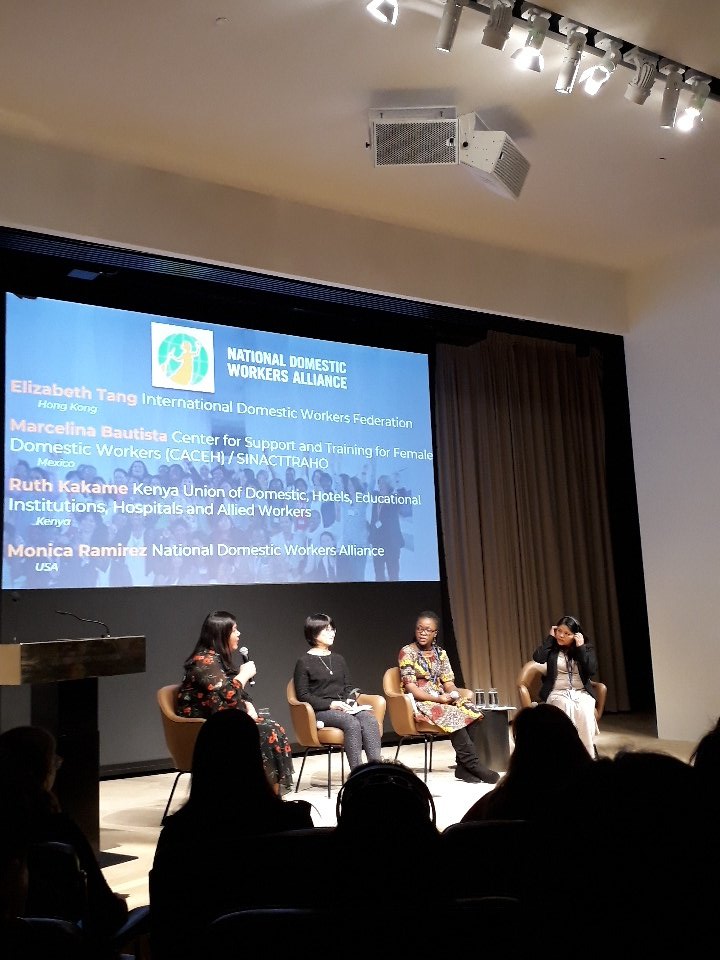
Our movie night started with an introduction by the President of the Ford Centre Darren Walker, the film was introduced to the audience via the voices of domestic workers.


To hear the panel discussion was powerful and insightful.  Domestic workers around the world are the great unseen, they care for our loved ones, organise our homes and are a part of our households.  However this section of the global workforce are the sector unlikely to be given basic workers rights as social protections, no maternity entitlements, paid leave, protective equipment, clear working hours or even a job description.

However the panel representing Asia, Africa and the Americas also demonstrated that with education, mobilisation and organisation the domestic workers sector can find and amplify their voices.

The film was brilliantly made and the story so well presented (no spoilers) however we agreed that to have the panel discussion first, helped to ground the fiction in real life.  This was not just about an Oscar winning film, it was very much about the voice of domestic workers.

Some people would question why this is an issue for teachers or teacher trade unionists? because we are all part of the same workforce and where there is exploitation, that impacts on us all.

I recommend Roma as it gives visibility and voice to those whose job it is to be invisible, but we must see the person and protect their rights to a just and fair working environment and life balance.

#CSW63 UN CSW 63 Opening Ceremony

Monday 11th March 2019

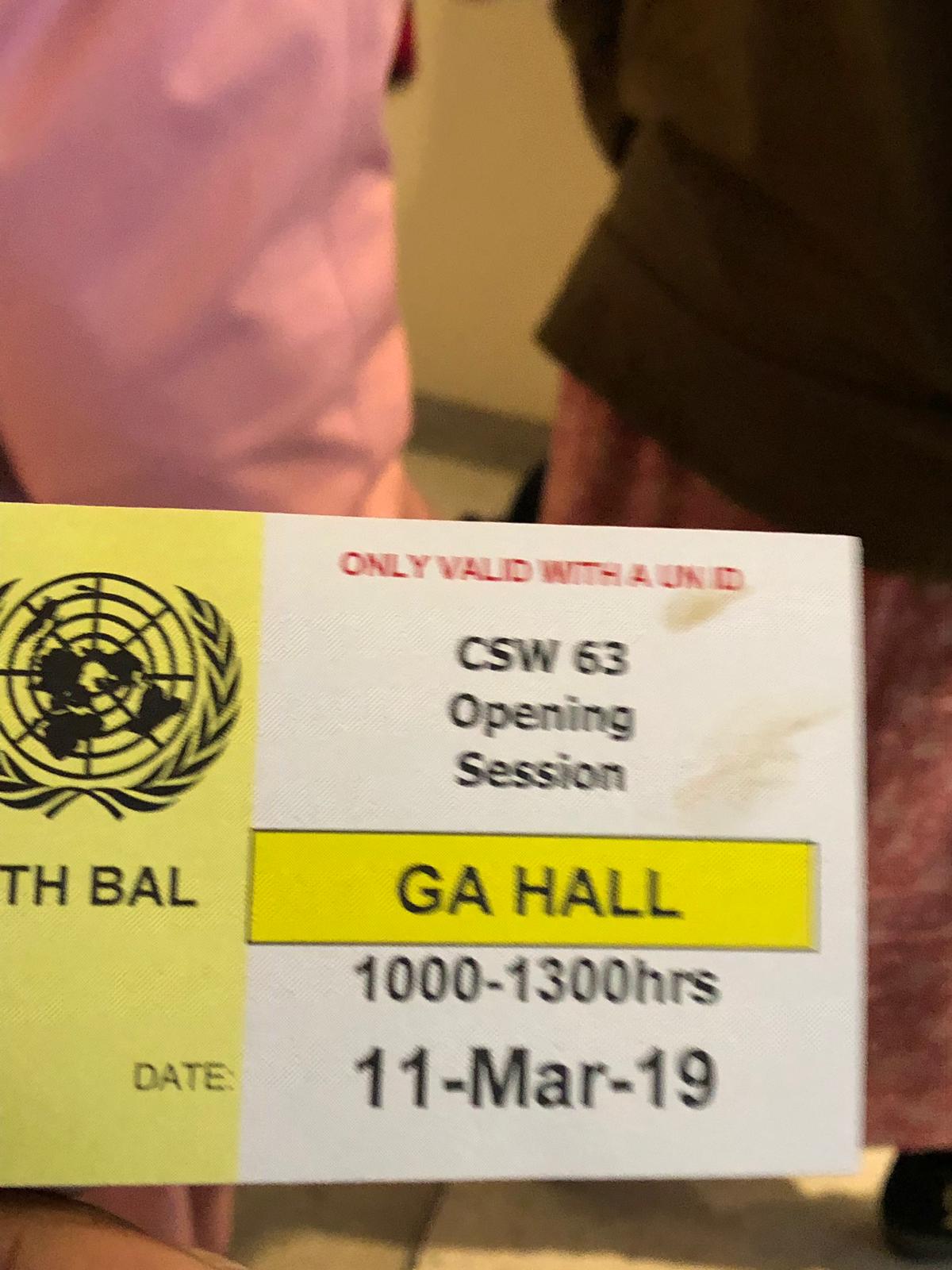
My first day at #CSW and I got a golden ticket!!!!

With many panicked messages and phone calls, our fantastic delegation leaders finally got me to pick up my phone and I was glad I did! Rebeca and Madeline offered me a ticket and I was into the chamber.

After nearly causing an incident at security (through a drink and lots of badges) I made it through to the other side and what a sight, my breath caught as I saw this wide space in the middle of New York.  My first thoughts were peaceful and thoughtful, even with so many people milling around and taking pictures.

I was quickly ushered through to the entrance hall where I am straight away faced with a statue of Nelson Mandela with his arms wide welcoming me to the building.  I felt at home, as Mandela stands in Parliament Square and welcomes us when I take groups of students to visit Parliament. Mandela felt like home.

Yesterday was a true moment for me.

I have taught about the UN, it’s positives and negatives for my whole teaching career and yesterday I was literally in the room where it happened.

I queued for the lifts and went up to the 4th floor. As I showed my pass and ID, I again took a breath as I entered the upper level of the chamber - I wasn't disappointed!


I had 2 phones in my hands, live videoing on FB and Twitter. I was tweeting and posting pictures. I was writing notes and I was listening - I looked like a crazy woman! 

But I felt so privileged to be in this space on behalf of Education International.

The opening was started by speeches from the President of #CSW63, the Secretary General of the UN and a representative of the Security Council.  The messages were powerful. We were reminded that when women are excluded, we all weep and that when the competency of women are constantly questioned then we lose out on the best talent.  My favourite quote was that "It's not enough to add women and stir", the clear call for true women's rights and not tokenistic gestures was loud.

We were told how the UN is trying to get its own house in order, with more women around the table of the Secretary-General who as an avowed feminist himself, is actively recruiting and promoting women.  As he said, when women are involved in the decision making and negotiations then decisions stick and are successful. Proving that it is important to have women at all levels of decision making. 

The work the Security Council are doing around the use of sexual violence during conflict is moving up a next level to now collecting data to actually measure if the actions taken are making an impact.  The fact that 70% of the resolutions relate back to women and girls, and 90% of the presidential statements does the same, shows a push to recognise the issue.  However to admit that more women blue helmets and negotiators.

There was so much reference to the importance of education and teaching (maybe should have been some more on the importance of women teachers but that's just me!)
I got an opportunity that only some get, to be a teeny, tiny part of the process of drafting a resolution that will have an impact on the lives of women and girls around the world if governments get it right.

The UN clearly have women and girls on the agenda, however as an organisation it is also honest about the fact that more needs to be done, and time is running out for the organisation to meet the deadline of the Beijing Declaration. However the fact that Gender Equality is "no longer an option discussed at the end of the meeting, if we have time" as said by the representative of the security council, shows that there is a large amount of political will to keep gender on the table.


Watch Video: Opening Ceremony #CSW63

Watch video: Sec-Gen Statement to CSW63

UN Secretary General's Remarks #CSW63 11/3/19

Tuesday, March 12, 2019

#CSW63 Self-Care

Tuesday 11th March 2019

Reflections for the day is that the #CSW63 is a powerful and empowering space for women. Whether you are an NGO, diplomat, trade unionist, campaigner, this week is about engaging with the wide picture of discrimination faced by women and girls across the world.

Although we are being given examples of where our activism is working and improving the lives of our sisters, unfortunately this is overtaken by examples of where we need to work or try harder.

We are activists because we are able to empathise and sympathise in connection with our sisters across the world, but what motivates us is the willingness and skills to take action.

We are here this week because we are driven to make a difference.

BUT as activists we also must look after our wellbeing, activist burnout is a very real consequence of being active. And as activists we often sacrifice ourselves for the struggle.

However we are too important to the struggle to not look after ourselves.

It is not selfish to step away from the emails/phone/letters to do something else.

It is not selfish to spend time socialising with your friends and family.

It is not selfish to go on holiday and not take your phone.

It is not selfish to not spend another Saturday organising a rally or march. to go watch your children play sport or visit your mother.

As a first time attendee to #CSW63 it is important to note that we must prioritise self care:
  • Try to give your self space in between sessions to think and reconcile what you have heard
  • Identify one thing you will do as a result of what you have heard- ie post about it on social media, talk to sister about your thoughts,  send an email, 
  • Emotionally rebalance - hug it out, cry or laugh, go for a walk, read a book/magazine, watch a cat video :) 
  • Find yourself - remember why you are involved in the struggle, what drove you to get active
As activists, we are only as good as our own wellbeing. Our strength is the capacity to fight for others but we must also fight for ourselves too.  We are all part of a wider struggle, we are all linked and connected so we must look after each other and be a strength to our sisters, aunts, daughters, mothers, grandmothers.

We matter, because our sisters matter

Monday, March 11, 2019

#CSW63 What is 'intersectional'?

Tuesday 11th March 2019

There have been references to the need for intersectional perspective when discussing all of the issues impacting on women's rights.

The first message I understood from #CSW63, its the importance to remember that Women's Rights are Human Rights. As was said at the opening ceremony by the representative of the UN Security Council, it is unacceptable that in 2019 50% of humanity is not afforded the full rights that all humans deserve.

As she said "We can't be happy with this!"

However it's important to note that is a variation of the understanding of the term 'Intersectional'.  It appears in UN language, intersectional is about the experiences and positions that women find themselves in i.e. women refugees, women domestic workers, women social activists.

Alternatively in the UK and the USA when we talk about Intersectionality, its where our cultural and membership of personal communities meet.  These are like 'secret' identities which we use to interact with others inside or outside of those cultural identity.

A few of these include:
Biological Sex
Ethnicity
Sexual Orientation
Gender Identity
Nationality (or country of origin)
Cultural Heritage
Religion
Social/Economic Status


 i.e. a Black (ethnicity) Cis-Woman (gender & biological sex) or a Lesbian (sexual orientation), Indigienous (cultural heritage) Trans-Woman (Gender)  or a Non-Binary (Gender identity) Migrant (nationality or social/economic status)

It is crucial to acknowledge that we all have an intersectional identity, which helps us to decode the world around us and that due to the experiences we have and how we have developed these 'secret identities' means that we may find a commonality with those with similar identities but also due to the mix, we may also have differences.

At the end of the day, we have to give individuals and groups the space to form these identities, acknowledge and amplify their voices irrespective of which 'secret identity' they are wearing that day.

As women activists we have a duty to provide a space for each other where we can learn from all of our experiences, as use these interactions as a way to strengthen the sisterhood.  Through understanding, empathy and compassion we should always find an opportunity to build up another sister's voice.

#CSW63 The Goal

Sunday 10th March 2019

So what is the goal of #CSW63 ?

Overall, it is to get member states of the UN to formally propose and adopt a set of agreed conclusions.

The process started weeks ago where the UN came up with a framework for discussion (as identified by an expert group) this then led to a production of a Zero draft. by the UN Office of Women.

Countries were then invited to comment on the Zero draft by submitting amendments.

All the amendments are drawn together to produce a huge document called a compilation draft.

This version of the draft is then submitted for a first read through and it is because of this the document then starts getting 'tidied up' and the draft becomes more readable.

It is at this stage when the NGOs, civil societies and trade unions are invited to influence their government representatives to ensure their contributions to the agreed conclusion draft represents the needs of the women in the parts of the world they represent.

#CSW63 the focus as NGOs etc are running their own parallel process with their own Zero start point.


When we talk about UN resolutions and the Millennium Development Goals, those of us outside of the drafting process are completely how much work goes into producing a final document.

As a citizenship teacher I talk about the Universal Declaration of Human Rights and the UN Convention on the Rights of the Child constantly in class without truly understanding how we've arrived at a final document that can be reduced 2 one double sided sheet that my year 9 classes stick in their books.

These resolutions and conclusions have a direct impact on the lives of millions of people around the world, so it is crucial to get the correct wording and sentiment as well as because the hardest part will be to get governments to not just agree to the resolutions, but also to put time and resources into achieving them.

The deadline is 2030 and the ILO are calling for a true 'quantum leap' to be able to reach this target date.  But with a number of countries objecting to references to reproduction rights for women or references to LGBTIQ rights, there is clearly a lot of work to be done.


#CSW63 Meeting the Delegation

Sunday 10th March 2019

Today we finally all met (in person) the Education International delegation and it was quick to realise that whether woman teachers are in Canada, Norway, Germany, Jamaica or Canada there is more commonality than differences.

All of us have identified where women activists are still fighting for their own place in their unions, women make up 70-80% of the education workforce globally, yet there are still huge barriers to women educators becoming leaders in the union movement.  

The talent and brilliance in this room hit like a brick to the head, how much talent is lost from the movement because so  many women are not able to have their voices heard within the movement where we are in the majority!

To say I felt humbled, was an understatement.

This week I am prepared to listen to the voices of sisters from around the world who are fighting for the survival of their cultures, communities and their lives.  All of our battles are relative, but most importantly they are all linked.  If women in one part of the world have been denied their right to thrive (not just survive) then that is an attack on all of us, women (and men).

Today, this was the message I felt.  Meeting the rest of the Global Unions Delegation to #CSW63 also made me realise how much work goes into am international resolutions. The challenges and fights that happen before the document is published on line. 

Today's battle for women's rights was kicked off

Our fight will prevail!

Women together? Be very aware


#CSW63 The Realisation of a Dream

Saturday 9th March 2019

Today was about arriving in New York and checking into the hotel.  Then the excitement of collecting my UN pass.

There is nothing that can describe the feeling when you walk past the UN Buildings in New Yorrk..  To know that Eleanor Roosevelt had a vision of a forum where countries can come together and discuss, debate and negotiate to avoid conflicts in the future. This was just an idea that the First Lady dremed of and went through the long process of setting up.  By cajoling and appealing to the best of nations Eleanor Roosevelt brought together those first few countries into the League of Nations.  But despite this initiative, World War 2 started and as a modern society we saw again the worst of human nature.  We saw what happens when those with power don't protect the" voiceless" and left our world worse.

Instead of the League of Nations collapsing, instead it became introspective and focused on being a stronger voice for the voiceless. The UN grew out of the ashes of post WW2 despair and provided hope for millions around the world.  But the UN as a structure, as an organisation is aware that it is imperfect. Yet Eleanor Roosevelt's dream prevails.

The UN continues to build spaces for the voiceless internationally and in their own front garden.  It helps to focus the power for moments in time, but also has the strength to continue with the mission.  The goal of the union is to make our world more just, more equal and more fair.  It is a symbol of hope and safety for so many around the world.

And this is why I geek out every time I think about the privilege I have as a representative of @NASUWT in the @Eduint sector of the Global Trade Union delegation to the UN Commission on the Status of Women 2019

Sunday, March 10, 2019

#CSW63 The Journey to This Point..

Friday 8th March 2019
Day 1 - Heathrow, London

Today is the start of my adventure. After a busy week at school, meetings to discuss taking union action in Oxfordshire schools and a national executive meeting at NASUWT HQ, I was finally on my way to London. My journey to be a guest of the UN is finally here.

I have been an activist since I was a teenager and a citizenship teacher for the past 14 years, and during this time I have been to many places where I have seen citizenship and the 'voice' find it's place.  I have taken a group of year 12s to the European Union and numerous KS3 classes to the Houses of Parliament and the Supreme Court. I have visited the Royal Court of Justice and had students argue cases as part of mock trials and I have watched American high school students present a mock trial at the NY court.

However, as a citizenship teacher the creation of the UN represents one of the points of our social history which was a clear attempt to learn from national division and patriotic short-sightedness of the  move our modern society towards a world focused more on social justice, fairness and equality.

So when I was offered the opportunity to attend the UN Commission on the status of Women was like the BAFTAs/Oscars/Grammys and Tonys all rolled into one!! (yes I was also a BA Media and Film Student) Excited was an understatement and my poor family had to put up with me behaving more and more like a 5 year old excited for Christmas as the day came closer.

To be able to say I am representing NASUWT-The Teachers Union as part of the Education International with teachers representing other countries across the world, then I knew I am truly privileged. My role as Junior Vice-President of  the only union that represents just teachers across the nations and British territories.  The fact that this conference is happening on the same week as International Women's Day, this is going to be an amazing time!

Thanks to Jennifer Moses (NASUWT Equalities legend) has already made sure I am in the right place at the right time. She will be a great travel buddy and I'm looking forward to it!!